Thursday, November 25, 2010

South Sudan vote


I got a chance to visit South Sudan to get a first hand look at the hopes and expectation that have arisen as Sudan prepares to go to the ballot box that will most probably see the split of Africa’s biggest nation

Many returning refugees such as Deng see the upcoming referendum as the ultimate crowning moment to years of healing and reconstruction by once an ailing region.
“We have fought and lost loved ones, many of us the only thing we can remember is the heartaches we went through and I do not want to see my children grow up like I did” said Deng.

Deng added that the referendum is Southerners golden chance for total independence and the residents there are prepared to see that happens. “If not for us then we are doing it for those who have lost their lives fighting for the independence and our children”

On January 9, 2011, the people of southern Sudan will vote in a referendum for self-determination, which is expected to result in the secession of the South.

Speaking to Deng and majority of other Sudanese you can hear the bitterness in their voices and the great urge to separate from the North.
“If this does happen we are prepared for war.

There is no way we can go back and start negotiating with the same people that have made us slaves, denied us equal rights and even killed majority of our families” said Deng
The ruling National Congress party looks set to romp back to power in the wake of an opposition boycott that challenges the credibility of the first multiparty elections in 24 years.

These are polls fraught with challenges and left in turmoil by partial boycotts by a number of opposition parties.

Fearing that their participation in the election would simply bestow legitimacy on a regime accused of conspiring to rig the results, the Sudan People's Liberation Movement (SPLM), south Sudan's ruling party and partner in the national coalition, announced a selective boycott.

Some of the north's major opposition parties are partially boycotting the polls too.
It is, however, SPLM's boycott of the polls that has raised eyebrows the most.
Salva Kiir, the SPLM leader and Sudan's vice-president, declined to run against Bashir and also withdrew his party's candidate for the national presidency, Yasir Arman, at the last minute, signalling his preference for secession in a referendum planned next year.


The party also withdrew its parliamentary candidates for constituencies in all but two regions of the north.

Five years of a power sharing agreement have no doubt left al-Bashir's National Congress party (NCP) and the SPLM distrustful of each other.

SPLM's boycott is also seen as a reaffirmation that the divisions between the largely Muslim north and the mainly Christian and animist south appear unbridgeable.
The referendum is part of the 2005 peace deal that brought to an end more than two decades of civil war fought over ethnicity, oil, religion and resources.

More than two million people died in the conflict between the Arab-dominated, Muslim government in the capital, Khartoum, and rebels from the marginalized south, where most are Christians or follow traditional beliefs.

Friday, August 20, 2010

South Africa unlikely to deploy troops in support of AMISOM in Somalia


South Africa is unlikely to deploy soldiers in support of the African Union Mission in Somalia (AMISOM).
The South African Cabinet was to make a decision on 18 August as to whether troops would join the peacekeeping mission, which is expected to last more than three years, but an indefinite national strike by public sector workers - with the army on standby to provide essential services - has delayed the decision,
Peacekeeping commitments in Burundi, which ended on 30 June 2009, meant South Africa had previously declined to participate in AMISOM, but on 23 July 2010 AU Commission Chairperson Jean Ping requested South Africa, Angola, Nigeria, Ghana and Guinea to send troops to Somalia to bolster AMISOM.

Ping's plea for support came shortly after suicide bombers from Al-Shaabab, a non-state Somali group, killed 76 people in attacks in Kampala, capital of Uganda, after assaults on Ugandan and Burundian troops by Al-Shaabab militia in Somalia's capital, Mogadishu.

The peacekeepers in Somalia were operating under a "limited mandate" and had failed to bring stability to Mogadishu, which had resulted in daily artillery duels and firefights
However according to analyst, they continue to warn that simply increasing AMISOM's size is unlikely to succeed unless accompanied by a political solution.

Why young Somalis join Al Shaabab


As the long-running civil war shows no sign of ending, over the past few months, many young Somalis have left the comfort of their home in different part of the world to come and fight in the home that they barely know.

There have been reports that the radical Islamist group al-Shabaab has been recruiting fighters from different part of the world to come back and fight in the war torn Somalia.

“Young people are targeted because of their idealistic nature and when they are not properly educated they can easily be manipulated” says Rashid Abdi Analyst for International Crisis Group in the Horn of Africa
He added that the young people from the Diaspora become easy targets for Al Shaabab because they find it hard to adjust to life in the west and at times the discrimination faced makes them reconsider.

“For the foreign recruits, it’s never about the money, it’s the jihadist ideology because you also have people paying their own air ticket just to come back, that’s not money, it’s their beliefs” remarks Abdi.

In August, US officials charged 14 people with providing money, personnel and services to the Somali militant group al-Shabab. The charges stem from four separate indictments in the US states of Minnesota, Alabama and California.
In two separate indictments, prosecutors charged Shafik Hammami, a former resident of the US state of Alabama, and Jehad Serwan Mostafa, formerly of California, with providing material support to al-Shaabab.
“Al Shaabab is a well resourced army, apart from having the money to pay their forces, they enjoy a strategic ideological well committed army,” says Abdi adding that the Islamic Insurgent are now targeting the young people from the Diaspora. “ the fact that over 4 million people live outside Somalia is reason enough for the radicals to target them” he said.

Somalia's youth have suffered 20-years of lawlessness, lack of education and employment opportunities, and have adopted acts of desperation to survive. The Insurgents group is one of the ways to survive.

The weak western Backed Transitional Federal Government has had hard time fighting the Insurgents. “Despite the International effort to help the TFG, they have not been able to pay their troops well because of the corruption, confusion of chain of command and parallel forces within the forces” he added

Ethiopian troops back in Somalia will worsen situation


Ethiopia back in Somalia

Ethiopian’s Prime Minister Meles Zenawi said he would send the soldiers in the unlikely scenario if the African Union's mission in Somalia (AMISOM) who is battling Islamist insurgents needs rescue.
If Ethiopia force goes back to Somalia, the Islamist rebels may get reinforcement from Somali community in the country and outside for the longtime historic conflicts Ethiopia and Somalia.
Ethiopia invaded the Horn of Africa nation in 2006 to oust the Union of Islamic Courts (UIC) which controlled southern Somalia but withdrew under a UN-backed peace deal early in 2009.
Its after the US backed Ethiopia invasion that the UIC decalred a holy war on Ethopia.
It's been almost two decades since U.S troops were forced out of Somalia after the "Black Hawk Down" battle. Now, the U.S. is backing a push by African states to add troops to combat Somali militants.

But Somalia experts who have watched violence spin in circles for nearly 20 years are warning that more troops will not bring peace, and will encounter fierce resistance from the dangerous militant group that claimed deadly twin bombings in Uganda last month.
According to the International Crisis Group, Analyst for the Horn of Africa, Military approaches have only helped to radicalize more youths and exacerbate fundamentalism in Somalia," he said. "The international community needs to realize that itscurrent and previous policies on Somalia have largely strengthened religious extremism and Somalis' distrust of the West."

Thursday, August 12, 2010

Islamist Group ban Christian Organisations in Somalia


Al Shaabab close down Christian organizations

The radical Islamists militant group Al Shaabab has just announced the closure of three Christian humanitarian organizations operating inside Somalia.

As for today, World vision, Adventist Development and Relief Agency (ADRA) and DIAKONIA, A Christian Development Organization have all been banned from conducting their operation in Somalia.

Through a press release, the Islamist group said that the organizations have been propagating Christianity in a Muslim country.

“Acting as missionaries under the guise of humanitarian work, the organizations have been spreading their corrupted ideologies in order to taint the pure creed of Muslims in Somalia” said the press statement.

All the NGO’s and organizations have also been warned if found to be engaging in similar activities they will be closed down and they will face disciplinary measures.

The press release from the office of supervising the Affairs of Foreign Agencies, Safeguarding the welfare of the Muslim population, Harakat Al Shaabab Al Mujahideen said they will take action against anyone propagating against Islam.
Despite the warning ADRA says it will continues its operation in Somalia and have denied claims that they have been propagating Christianity messages in Somalia.

“We are there to provide aid to the residents living in Somalia, nothing else. The ban is a big blow to the Somali people who majority of them were depending on the aid we are giving them” Said Joseph Njuguna project manager ADRA Somalia.

World vision Somalia has also agreed to have received the information but say that they are still having meetings to discuss way forward.

“We have just heard about the directive by the group, we shall have meeting to discuss this and then react to the information” said World Vision Communication Manager Amanda Oketch.

Tuesday, July 13, 2010

Al Shaabab threatens neighbouring countries


The Somali insurgents continue to protest over deployment of the African Union Peacekeepers in Somalia, took to the streets of Kismayo with automatic AK-47 riffles chanting slogans Intergovermental Authority Development and the UN backed Transitional Federal Government.

"We urge the Muslim people to join the jihad against the so-called IGAD members who are our enemies. We will attack them before they invade us," said Al-Shabaab commander Sheikh Bali who was speaking to the protesters in Kismayo.

The demonstrations also took place in Gedo, Middle Shabelle and Bay in southern Somalia, where mostly Al-Qaeda linked group of Al-Shabaab controls.

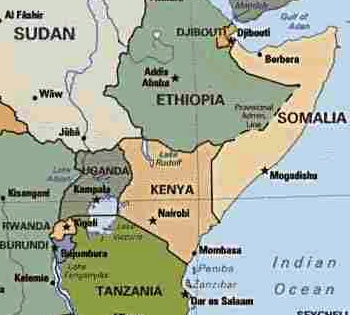
Leaders from Ethiopia, Kenya, Uganda, Sudan and Djibouti who met in an emergency summit in Addis Ababa decided to deploy 2,000 peacekeepers to Somalia to join other 6,000 peacekeepers from Uganda and Burundi.

The leaders also recommended United Nations to send an additional 20,000 peacekeeping force to Somalia. The protesters denounced forces from neighbouring countries especially Ethiopia which pulled out from Somalia last year after three years of occupied.

The deployment of the AU Soldiers led the Somalis insurgent group Al-Shaabab threatening that they will attack the capitals of Burundi and Uganda in revenge for rocket attacks by peacekeepers from the two countries.

The threat follows the killing on Thursday of at least 30 people in Mogadishu, the capital, by Amisom, the African Union's peacekeeping force to which Uganda and Burundi contribute troops.

Somalia 50 years on


Even as Somalia celebrates its 50th independent day on July 1st, there is very little or nothing to celebrate. Somalia remains a dangerous place to live even for the Somali residents.

According to analyst the troubled nation can feel peace when the locals realize the need to sit on themselves and that their problems of can never be solved by the international community.

For many Somalis, they are witnessing the 50th anniversary for the country that collapsed 20 years ago and 14 failed attempts to have a stable government. This day is celebrated in their houses with saddened faces and anguish of what they once called home.

For the last 50 years the country showcases the failure of state, a country ruled by guns between unified people and divided country and the future portrays hopelessness.

Somalia is a showcase of the failure of post-colonial state in Africa; the state imposed from top against the culture and social norms of the people, and the state and elites that do not belong to the aspiration of their people. Somalia can also show the resilience and audacity of the traditional African society and their social networks and its survivability.

The instability in Somalia was caused with a lot of issues including lack of freedom, divided opposition and the Ethiopia factor which has led to the open space of Somalia became attractive to terrorist groups after 9/11 and wrong policies and approaches deteriorated the situation.


Although for the short term period the picture for peace in Somali is depressing a lot can still be done in Somalia and it all comes back to the people who have to sit down and deal with the issues that divide them.

The UN backed government is threatened and this is clearing the way for the extremist Al Shaabab who have controlled the majority of the Southern Somalia. According to analysts the only way out for Somalia is having a government that people have accepted and agreed on by them.